Searching for Water in the Desert
We are a week away from the Anthropic (ANT) IPO. It is predicted to be the largest IPO in history, despite an apparent assault from all sides. The news really does read like reality TV right now: Chinese spies, corporate espionage, nation-state actors, and high-profile infidelity. Beneath the sensational fray lies a quieter debate that I believe is at the core of this IPO: what is artificial superintelligence (ASI), and is it possible?
The bets on compute, and on the AI trade in general, are aligned to a future that no one knows. We have all encountered this technology and have varying degrees of mastery of it. Some are delighting in a sycophantic assistant that will always prop them up, while others are searching for productivity only to find it eluding them. The future of AI that commands trillions of dollars, and can justify it, has yet to be fully articulated.
Attempts have been made. Dario Amodei articulates it as a future without cancer. Elon Musk articulates it as a world ruled by logical systems. Joe Rogan articulates it in the classic binary of a hellish matrix or a heavenly utopia. All of these articulations presume seemingly unbounded progress in the underlying models.
The models have improved over the past five years. This is indisputable. However, the cost of driving that improvement has scaled much faster than the capability gains. The first few training runs cost millions of dollars, while a new model in early 2027 is expected to exceed a billion per run. And yet the improvement from each subsequent model is marginal, and the frontier labs are converging on capability.
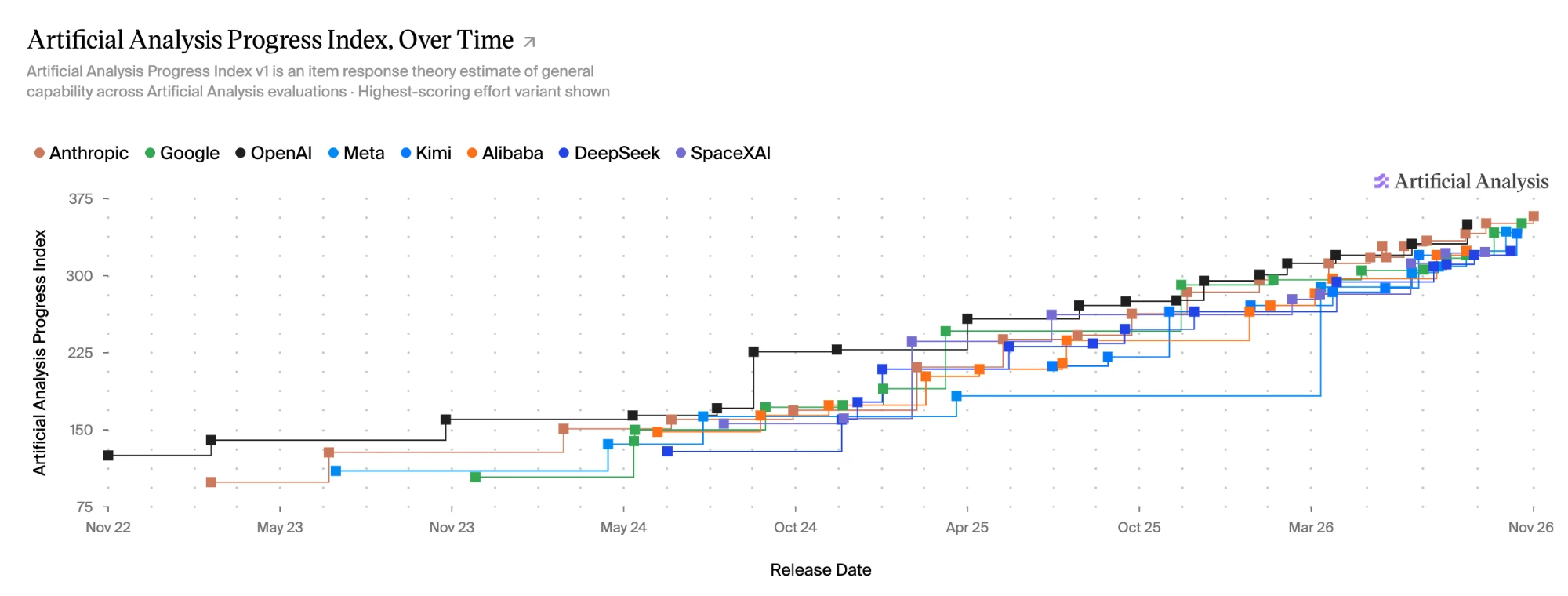
There is some speculation that once the models start unleashing recursive learning, the speed of progress will increase without bound. This could be true, though it presumes something deterministic about the world we live in. If complex dynamic systems can be mapped with enough compute, then eventually the models can contain the complexity of the world. If not, recursive learning only speeds up the search for water through the desert.
In complex dynamic systems, the inputs can't be mapped cleanly to the outputs. Prices are a great example. In 1945, Friedrich Hayek argued that the price system acts as a giant communication and information-processing machine. The word "machine" can delude us into assuming a degree of determinism. But prices in an economy are so complex and multivariate that they more closely resemble a biological ecosystem than a clean, formulaic system like plumbing.
Centrally planned economies fail, per Hayek, because a government board can never collect or process the vast and constantly changing local knowledge that market prices communicate effortlessly. ASI is the pursuit of a machine that can. The next step in that pursuit is using models to define the next frontier model. If complex dynamic systems can be mapped and understood, this will eventually succeed. If they cannot, the models are just speeding up a search through the desert for water.